Among the remarkable companions of Prophet Muhammad ﷺ, few names inspire as much admiration as Khalid ibn al-Walid رضي الله عنه. Known throughout Islamic history as Sayfullah (The Sword of Allah), Khalid ibn al-Walid remains one of the greatest military commanders the world has ever known.
His story is not merely one of military brilliance. It is a story of transformation, faith, humility, obedience, courage, and complete trust in Allah. From being one of Islam’s strongest opponents to becoming one of its greatest defenders, the life of Khalid ibn al-Walid رضي الله عنه demonstrates the power of guidance and the mercy of Allah.
For Muslims seeking inspiration from the lives of the Sahabah, authentic Islamic history, and lessons from the Quran and Sunnah, AlMuslimQuran.com provides valuable resources that help believers learn from the examples of the Prophet ﷺ and his noble companions.
Who Was Khalid ibn al-Walid?
Khalid ibn al-Walid ibn al-Mughirah رضي الله عنه was born into the powerful tribe of Quraysh in Makkah. He belonged to the respected Banu Makhzum clan, known for its leadership, wealth, and military expertise.
Even before accepting Islam, Khalid was recognized for his intelligence, courage, strength, and exceptional military abilities.
He was:
- Tall and physically powerful
- Highly respected among Quraysh
- A skilled horseman
- A brilliant strategist
- A natural leader
These qualities would later serve Islam in extraordinary ways.
However, during the early years of Islam, Khalid was among those who opposed Prophet Muhammad ﷺ.
The Influence of His Father
One reason for Khalid’s opposition to Islam was the influence of his father, Al-Walid ibn al-Mughirah.
Al-Walid was among the leaders of Quraysh who rejected the message of Islam. Historical narrations mention that he believed he was more deserving of prophethood than Muhammad ﷺ because of his status and influence.
The Quran repeatedly reminds humanity that Allah alone chooses His messengers and grants His blessings to whom He wills.
Growing up in this environment, Khalid often heard criticism of Islam.
He reportedly believed that accepting Islam would mean siding against his father’s position.
As a result, he remained distant from the message of the Prophet ﷺ for many years.
Khalid ibn al-Walid at the Battle of Uhud
One of the most significant moments before Khalid embraced Islam occurred during the Battle of Uhud.
At that time, Khalid was fighting on the side of Quraysh.
The Muslim army had initially gained an advantage. However, the Prophet ﷺ had instructed a group of archers to remain on a strategic mountain position regardless of the battle’s outcome.
When some archers left their positions, believing victory had already been secured, Khalid immediately recognized the opportunity.
Using his exceptional military instincts, he led a cavalry attack around the mountain and struck the Muslim forces from behind.
This maneuver changed the course of the battle and demonstrated Khalid’s remarkable strategic abilities.
Years later, those same abilities would become a powerful asset for Islam.
The Letter That Changed His Life
Despite his opposition to Islam, Allah had destined guidance for Khalid.
One day, he received a letter from his brother, Al-Walid ibn al-Walid رضي الله عنه, who had already accepted Islam.
The letter contained words that deeply impacted him.
His brother wrote:
“O my beloved brother Khalid, I have always known you to be an intelligent man. The Messenger of Allah ﷺ has been asking about you and saying, ‘Where is Khalid?'”
These words touched Khalid’s heart.
The fact that Prophet Muhammad ﷺ thought about him and hoped for his guidance affected him profoundly.
Sometimes a single sincere invitation can change the course of a person’s life forever.
The Dream That Guided Him to Islam
That night, Khalid experienced a dream.
He saw himself leaving a narrow, dry, barren land and entering a vast green landscape filled with beauty, life, and abundance.
When he awoke, he understood the meaning.
The barren land represented disbelief.
The green land represented Islam.
Allah was opening his heart to the truth.
This dream became one of the turning points that led him toward accepting Islam.
The Journey to Madinah
Soon afterward, Khalid secretly prepared to leave Makkah.
During his journey, he encountered two notable figures:
- Amr ibn al-As رضي الله عنه
- Uthman ibn Abi Talhah رضي الله عنه
As they traveled together, they eventually revealed their intentions.
Khalid said:
“We are going to Madinah to accept Islam.”
To his surprise, Amr ibn al-As smiled and replied:
“By Allah, I am going for the same reason.”
Allah was guiding multiple future leaders of Islam at the same time.
Their journey toward Madinah marked the beginning of a new chapter in Islamic history.
Khalid Accepts Islam
As they approached Madinah, Al-Walid ibn al-Walid rushed to greet his brother.
He informed Khalid that Prophet Muhammad ﷺ already knew he was coming.
When Khalid entered the presence of the Messenger of Allah ﷺ, he greeted him and embraced Islam.
The Prophet ﷺ was delighted.
The conversion of Khalid ibn al-Walid was a major victory for Islam.
Not because of his military skill alone, but because Islam had gained another sincere believer devoted to Allah.
The Battle of Mu’tah and the Birth of “The Sword of Allah”
One of the most famous moments in Khalid’s life occurred during the Battle of Mu’tah.
The Prophet ﷺ appointed three commanders for the Muslim army:
- Zayd ibn Harithah رضي الله عنه
- Ja’far ibn Abi Talib رضي الله عنه
- Abdullah ibn Rawahah رضي الله عنه
The Prophet instructed that leadership should pass from one commander to the next if a commander was martyred.
During the battle, all three commanders were martyred one after another.
The Muslim army faced a critical situation.
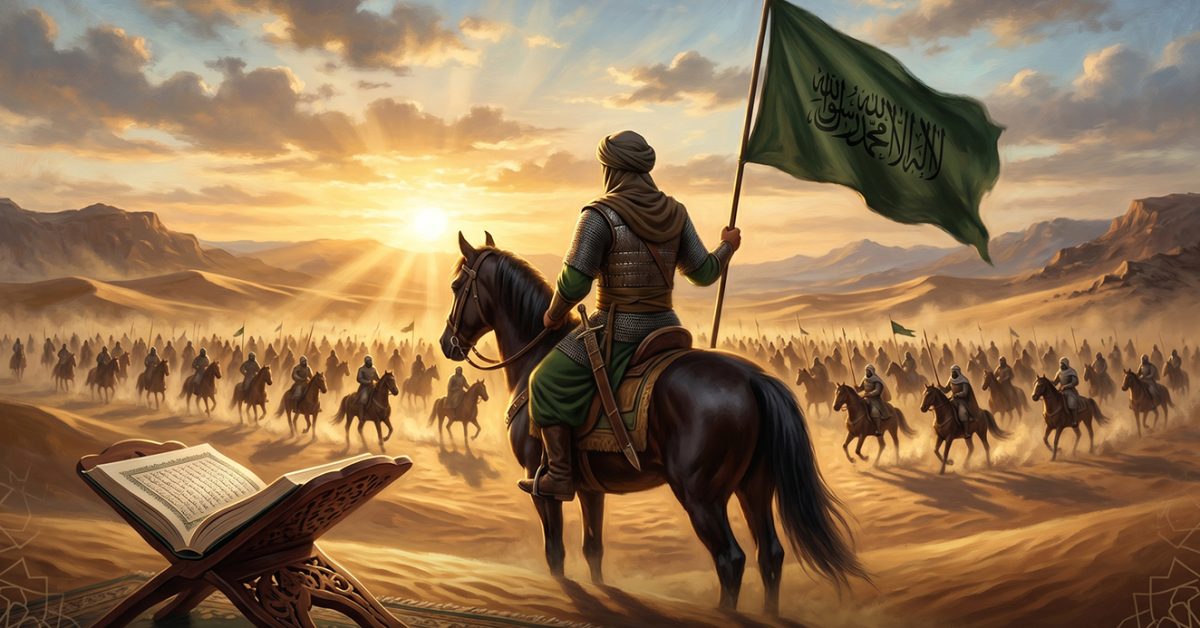
At this moment, Thabit ibn Arqam رضي الله عنه handed the battle flag to Khalid ibn al-Walid.
Khalid assumed command and skillfully reorganized the army.
Through his leadership, the Muslims avoided destruction and successfully withdrew while preserving the lives of many believers.
Meanwhile, in Madinah, Allah informed the Prophet ﷺ about the events occurring on the battlefield.
The Prophet ﷺ announced:
“Now a sword from among the swords of Allah has taken the banner.”
From that day forward, Khalid became known as:
Sayfullah — The Sword of Allah
It was one of the greatest honors ever given to a companion.
Military Genius in Service of Islam
After Mu’tah, Khalid’s military achievements became legendary.
He participated in numerous battles and campaigns.
Among the most significant were:
- The Conquest of Makkah
- The Battles of the Ridda Wars
- The Battle of Yarmouk
- Campaigns in Iraq
- Campaigns in Syria
Historians continue to study his military strategies today.
His leadership demonstrated:
- Tactical brilliance
- Courage under pressure
- Adaptability
- Strategic planning
- Decisive action
Remarkably, Khalid remained undefeated throughout his military career.
Many historians regard him as one of the greatest military commanders in world history.
The Conquest of Makkah
During the Conquest of Makkah, the Muslim army entered the city through multiple divisions.
Several distinguished companions commanded different sections.
Khalid ibn al-Walid led one of these divisions.
The conquest marked a historic moment when Islam triumphed peacefully over many years of persecution.
For Khalid, it represented a complete transformation.
The same man who once fought against Islam now played a key role in establishing its victory.
Umar ibn al-Khattab Removes Khalid
As Khalid’s victories continued, some people began attributing success to Khalid himself rather than to Allah.
This concerned the second Caliph, Umar ibn al-Khattab رضي الله عنه.
To protect the faith of the people, Umar removed Khalid from military command and appointed Abu Ubaydah ibn al-Jarrah رضي الله عنه.
Many leaders would have reacted with anger.
Khalid did not.
He obeyed immediately.
No complaints.
No resentment.
No demands.
His sincerity was evident.
He fought for Allah, not for rank or recognition.
Later, Umar explained:
“By Allah, I did not remove Khalid because I was displeased with him. I removed him because people were becoming attached to Khalid, while victory comes from Allah alone.”
This event highlights the greatness of both men.
Umar’s wisdom.
And Khalid’s humility.
Lessons Muslims Can Learn from Khalid ibn al-Walid
The life of Khalid offers valuable lessons for Muslims today.
Guidance Can Come at Any Time
Khalid spent years opposing Islam.
Yet Allah guided him when the time was right.
No one should ever lose hope in Allah’s mercy.
Intelligence Should Lead to Truth
Khalid’s intelligence ultimately led him to recognize the truth of Islam.
Knowledge should bring people closer to Allah.
Sincerity Matters More Than Position
When removed from leadership, Khalid remained obedient.
True believers serve Allah regardless of their title.
Trust Allah Completely
Khalid faced overwhelming odds throughout his life.
Yet he trusted Allah in every situation.
Remain Humble During Success
Despite countless victories, Khalid never forgot that success comes only from Allah.
The Final Days of Khalid ibn al-Walid
Near the end of his life, Khalid reflected on his extraordinary journey.
He looked at his body and said:
“By Allah, there is not a handspan on my body except that it contains a wound from a sword strike, spear thrust, or arrow.”
After spending decades on battlefields, he expected martyrdom.
Yet Allah had decreed otherwise.
He continued:
“Yet here I am, dying on my bed like a camel.”
Then he said:
“May the eyes of cowards never sleep.”
These words reflected a lifetime of courage and sacrifice.
Why the Sword of Allah Did Not Die in Battle
Scholars often reflect upon the wisdom behind Khalid’s death.
Allah honored him with the title “The Sword of Allah.”
Had he been killed in battle, some might have said:
“The Sword of Allah has been broken.”
Instead, Allah preserved his honor until the end of his life.
The Sword of Allah remained undefeated.
His story became a symbol of divine support, courage, and faith.
His Legacy Lives On
Khalid ibn al-Walid رضي الله عنه passed away in Hims (modern-day Homs, Syria).
His legacy continues more than fourteen centuries later.
Muslims remember him for:
- His courage
- His sincerity
- His obedience
- His military genius
- His love for Islam
- His unwavering trust in Allah
For those studying Islamic history, the biographies of the Sahabah provide invaluable lessons about faith, sacrifice, and character.
Platforms like AlMuslimQuran.com help Muslims connect with these inspiring stories while deepening their understanding of the Quran, Sunnah, and Islamic teachings.
Conclusion
Khalid ibn al-Walid رضي الله عنه was far more than a military commander.
He was a servant of Allah.
He was a companion of the Prophet ﷺ.
He was a man who transformed from an opponent of Islam into one of its greatest defenders.
His life teaches us that true success comes from Allah, sincerity matters more than status, and guidance is among the greatest blessings Allah can bestow upon a person.
May Allah be pleased with Khalid ibn al-Walid رضي الله عنه, the Sword of Allah, and allow us to learn from his courage, humility, obedience, and unwavering faith.
Ameen.