Ayat ul Kursi, the famous Verse of the Throne, is one of the most well-known and frequently recited verses of the Quran. It is found in Surah Al-Baqarah, verse 255, and describes some of the greatest attributes of Allah: His absolute oneness, perfect life, complete knowledge, authority over the heavens and the earth, and His power to preserve all creation.
The importance of Ayat ul Kursi is not based simply on its popularity among Muslims. Its special status is established through authentic Islamic evidence. The Prophet Muhammad ﷺ described it as the greatest verse in the Book of Allah, according to a hadith recorded in Sahih Muslim.
Ayat ul Kursi is also specifically mentioned in an authentic hadith concerning recitation before going to sleep. The Prophet ﷺ confirmed that whoever recites it at bedtime will have protection from Satan until morning.
For Muslims, therefore, learning Ayat ul Kursi is not only about memorizing a familiar verse. Understanding its meaning helps strengthen belief in Allah and reminds a believer of His perfect knowledge, power, ownership, and protection.
Quick Answer: Why Is Ayat ul Kursi Important?
Here are the main points to remember about the importance and benefits of Ayat ul Kursi:
- Ayat ul Kursi is Surah Al-Baqarah 2:255.
- The Prophet Muhammad ﷺ described it as the greatest verse of the Quran in an authentic hadith.
- It teaches important foundations of Islamic belief, especially Allah’s oneness and perfect attributes.
- It affirms that Allah is Al-Hayy, the Ever-Living, and Al-Qayyum, the One who sustains and maintains creation.
- It teaches that Allah neither becomes drowsy nor sleeps.
- It reminds Muslims that everything in the heavens and earth belongs to Allah.
- It explains that no one can intercede except with Allah’s permission.
- It teaches that Allah’s knowledge encompasses everything, while human knowledge is limited.
- Authentic evidence establishes the virtue of reciting Ayat ul Kursi before sleeping for protection from Satan until morning.
- Muslims should avoid attaching unsupported promises to Ayat ul Kursi, such as guaranteed wealth, marriage, healing, or success.
What Is Ayat ul Kursi?
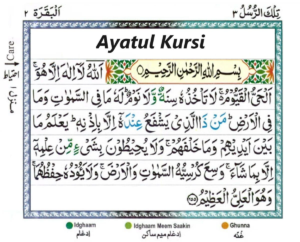
Ayat ul Kursi is verse 255 of Surah Al-Baqarah, the second chapter of the Quran.
The name “Ayat ul Kursi” means “the Verse of the Kursi” or commonly, “the Verse of the Throne.” The verse contains a description of Allah’s majesty and authority and includes the statement that His Kursi extends over the heavens and the earth.
It is important to understand that Ayat ul Kursi is one verse, not an entire surah. It should therefore not be confused with the verses immediately before or after it.
The verse comes after the discussion of Allah’s authority and faith in the early part of Surah Al-Baqarah. Its powerful message centers on Allah’s unique nature and His complete control over creation.
The Quran states, in meaning, that Allah alone is worthy of worship; He is the Ever-Living and the One who sustains everything. Neither drowsiness nor sleep overtakes Him. Everything in the heavens and earth belongs to Him, His knowledge encompasses His creation, and preserving the heavens and earth does not burden Him. The verse ends by describing Allah as the Most High and the Most Great.
Importance and benefits of Ayat ul Kursi in the Quran
Ayat ul Kursi is found in:
Surah: Al-Baqarah
Chapter: 2
Verse: 255
The verse is especially significant because it gathers many major teachings about Allah into a single passage.
Rather than treating Ayat ul Kursi merely as a protective recitation, Muslims should also study what it actually says.
1. Allah Alone Deserves Worship
The verse begins by affirming that there is no deity worthy of worship except Allah.
This is the foundation of Tawheed, the Islamic belief in the oneness of Allah.
A Muslim’s relationship with Allah should therefore be based on worshipping Him alone, relying upon Him, seeking His help, and avoiding anything that contradicts sincere belief in His oneness.
2. Allah Is Al-Hayy — The Ever-Living
Ayat ul Kursi describes Allah as Al-Hayy, meaning the Ever-Living.
Human beings have limited lives. Every person is born, grows older, becomes weaker, and eventually dies. Allah, however, is not subject to these limitations.
This teaches the believer that Allah’s existence is perfect and everlasting.
3. Allah Is Al-Qayyum — The Sustainer
The verse also describes Allah as Al-Qayyum, a name conveying His perfect self-sufficiency and His sustaining of creation.
Everything created depends upon Allah, while Allah does not depend upon His creation.
This is an important lesson for Muslims who experience uncertainty, fear, or hardship. A believer may recognize that people and circumstances can change, but Allah remains in control.
4. Allah Does Not Sleep
Ayat ul Kursi states that neither drowsiness nor sleep overtakes Allah.
This establishes the perfection of Allah’s attributes and distinguishes the Creator from His creation.
Human beings need rest. Allah does not.
The verse therefore reminds believers that Allah’s knowledge and authority are never interrupted.
5. Everything Belongs to Allah
Ayat ul Kursi declares that whatever is in the heavens and whatever is on earth belongs to Allah.
This teaches the believer about Allah’s complete ownership.
Our possessions, abilities, families, opportunities, health, knowledge, and worldly circumstances are all ultimately under Allah’s ownership and control.
6. Allah’s Knowledge Is Complete
The verse emphasizes Allah’s perfect knowledge.
Allah knows what is before His creation and what is behind them, while human beings only know what Allah allows them to know.
This should produce humility. No matter how much knowledge a person gains, human knowledge remains limited.
7. Allah’s Authority Is Perfect
The verse asks who can intercede with Allah except by His permission.
This teaches that nobody possesses independent authority over Allah’s judgment.
Islam recognizes intercession, but it is not something controlled independently by people. It takes place according to Allah’s permission and will.
8. Allah’s Preservation of Creation Does Not Burden Him
Importance and benefits of Ayat ul Kursi concludes by emphasizing that preserving the heavens and earth does not tire or burden Allah.
This is a powerful reminder of Allah’s greatness and ability.
The believer does not need to imagine Allah’s control over creation as something difficult or exhausting. Allah’s power is perfect.
What Does Ayat ul Kursi Mean?
The central message of Ayat ul Kursi can be summarized in several connected ideas:
Allah is One.
There is no deity worthy of worship except Him.
Allah is perfect in life and sustenance.
He is Al-Hayy and Al-Qayyum.
Allah is never overcome by weakness.
He does not become drowsy or sleep.
Allah owns creation.
Everything in the heavens and earth belongs to Him.
Allah has complete knowledge.
Nothing is hidden from Him.
Allah has complete authority.
No one can intercede independently of His permission.
Allah’s dominion is immense.
His Kursi extends over the heavens and the earth.
Allah’s power is perfect.
Preserving creation does not burden Him.
Allah is the Most High and the Most Great.
This is why learning the meaning of Ayat ul Kursi is so important. Memorization allows a person to recite it, but understanding allows the verse to shape the believer’s faith.
Why Is Ayat ul Kursi Called the Greatest Verse of the Quran?
One of the clearest authentic evidences for the special status of Ayat ul Kursi is the hadith of Ubayy ibn Ka’b رضي الله عنه.
The Prophet Muhammad ﷺ asked him which verse from the Book of Allah was the greatest. Ubayy رضي الله عنه identified the verse beginning with the declaration that Allah is the only deity and is the Ever-Living and Sustainer.
The Prophet ﷺ approved his answer and praised him for his knowledge.
This narration is recorded in Sahih Muslim 810, making it an important authentic source concerning the virtue of Ayat ul Kursi.
The reason for this greatness can be understood from the content of the verse itself. It brings together fundamental truths about Allah’s:
- Oneness
- Life
- Sustaining power
- Knowledge
- Ownership
- Authority
- Greatness
- Preservation of creation
In other words, Ayat ul Kursi is not great merely because it is short or easy to memorize. Its greatness is connected to the tremendous subject matter it contains.
Benefits and Importance of Ayat ul Kursi
When discussing the importance and benefits of Ayat ul Kursi, it is important to stay within what Islamic evidence actually establishes.
1. It Strengthens Understanding of Tawheed
Ayat ul Kursi begins with the foundation of Islamic belief: there is no deity worthy of worship except Allah.
Regularly reflecting upon this message can help a Muslim remember who deserves worship and ultimate reliance.
2. It Reminds the Believer of Allah’s Greatness
The verse describes Allah using powerful meanings: the Ever-Living, the Sustainer, the One whose knowledge encompasses creation, and the One who owns the heavens and earth.
Reflecting on these meanings can increase awareness of Allah’s greatness.
3. It Encourages Reliance on Allah
When a Muslim understands that everything belongs to Allah and that His knowledge and authority are perfect, this can strengthen tawakkul, reliance upon Allah.
Tawakkul does not mean abandoning effort. A Muslim takes appropriate means while trusting Allah with the outcome.
4. It Teaches Humility
Ayat ul Kursi reminds human beings that their knowledge is limited.
People may understand many things about the world, but they do not possess unlimited knowledge. Allah knows what people do not.
This encourages humility rather than pride.
5. It Has an Authentic Virtue Connected With Nighttime Protection
The most specific authentic practical benefit associated with Ayat ul Kursi comes from the hadith of Abu Hurayrah رضي الله عنه.
In Sahih al-Bukhari, Abu Hurayrah رضي الله عنه was told to recite Ayat ul Kursi before going to bed. The person who gave him this advice was later identified by the Prophet ﷺ as Satan, but the Prophet ﷺ confirmed that what he had said about reciting Ayat ul Kursi was true. The report states that whoever recites it before sleeping will have a guardian from Allah and Satan will not approach him until morning.
This is a particularly important point because the report does not merely represent a popular cultural practice. The Prophet ﷺ confirmed the statement.
Is Reciting Ayat ul Kursi Before Sleeping Sunnah?
Yes.
There is authentic evidence for reciting Ayat ul Kursi before sleeping.
The hadith in Sahih al-Bukhari 2311 reports that Abu Hurayrah رضي الله عنه was advised to recite Ayat ul Kursi before going to bed. The Prophet ﷺ confirmed the truth of this specific advice.
Therefore, a Muslim who wants to establish a simple bedtime practice can include Ayat ul Kursi in the routine.
A practical routine can be:
- Prepare for sleep.
- Recite Ayat ul Kursi from beginning to end.
- Reflect briefly on its meaning.
- Go to sleep relying upon Allah.
The purpose is not to treat the verse as a magical formula. It is an act of Quran recitation and a Sunnah-supported means of seeking Allah’s protection.
Is There a Specific Number of Times Ayat ul Kursi Must Be Recited?
There is no authentic evidence in the sources discussed above establishing that a person must recite Ayat ul Kursi a particular number of times every day to receive its general benefits.
For example, Muslims should be cautious about claims that Ayat ul Kursi must always be recited exactly 3, 7, 11, 41, or another specific number for a particular worldly result.
A person may recite Quran frequently and repeatedly, but a specific religious number or guaranteed outcome requires evidence.
This distinction is important because many practices circulate online without reliable references.
Should Ayat ul Kursi Be Recited After Every Obligatory Prayer?
A narration is commonly cited regarding reciting Ayat ul Kursi after each obligatory prayer. However, scholars have differed regarding the strength of the relevant report and its chain.
For that reason, it is better not to present the claim as though there were no scholarly discussion about its authenticity.
A Muslim may certainly recite Ayat ul Kursi as Quran and remembrance of Allah. However, when teaching others, it is important to distinguish between:
- practices established by strong, authentic evidence;
- reports whose grading has been disputed; and
- popular customs for which no reliable evidence has been established.
The bedtime recitation, by contrast, has clear support in Sahih al-Bukhari.
Does Ayat ul Kursi Protect From Evil?
There is authentic evidence for protection from Satan specifically in connection with reciting Ayat ul Kursi before sleeping.
The wording and context of the Sahih al-Bukhari report should be respected. It establishes a particular virtue rather than a broad promise that reciting the verse automatically prevents every possible harm in every situation.
Muslims should therefore avoid turning the verse into a general superstition.
Ayat ul Kursi is Quran. It should be recited as an act of worship, faith, remembrance, and reliance upon Allah.
Can Ayat ul Kursi Guarantee Wealth, Marriage, Health, or Success?
There is no basis for claiming that Ayat ul Kursi is a guaranteed formula for obtaining specific worldly outcomes such as:
- becoming wealthy;
- getting married quickly;
- passing an examination;
- receiving a particular job;
- solving every family problem;
- curing every illness; or
- achieving every personal wish.
Allah may grant a person blessings after Quran recitation, dua, worship, or other righteous deeds, but Muslims should not promise a particular worldly result without authentic evidence.
This is especially important when religious content is shared on social media.
The Quran should never be reduced to a list of guaranteed worldly formulas.
Common Misconceptions About Ayat ul Kursi
Misconception 1: Ayat ul Kursi Is a Separate Surah
It is not.
Ayat ul Kursi is Surah Al-Baqarah, verse 255.
Misconception 2: It Is Only About Protection
Protection is certainly part of the authentic evidence concerning its recitation before sleep.
However, the verse itself is primarily a profound statement about Allah’s attributes, authority, knowledge, ownership, and greatness.
Reducing it to a protective formula misses much of its meaning.
Misconception 3: A Specific Number Must Always Be Used
No universally required number is established in the authentic bedtime hadith.
Muslims should be careful with online claims assigning special numbers without evidence.
Misconception 4: Recitation Automatically Guarantees a Worldly Result
The Quran is guidance and worship. Muslims should not make promises that Allah has not made.
Misconception 5: Memorization Is Enough
Memorizing Ayat ul Kursi is valuable, but understanding its meaning makes the practice more meaningful.
A child who understands that Allah knows everything, owns everything, and never sleeps is learning something much deeper than pronunciation alone.
How to Learn Ayat ul Kursi Correctly
If you are learning Ayat ul Kursi for the first time, avoid trying to memorize the entire verse in one sitting.
Step 1: Listen to a Correct Recitation
Listen to a reliable Quran reciter and pay attention to pronunciation.
Step 2: Divide the Verse Into Sections
Break the verse into small portions and repeat each portion until it becomes familiar.
Step 3: Learn the Meaning
Study the meaning alongside the Arabic.
Understanding phrases such as Al-Hayy, Al-Qayyum, Allah’s knowledge, and His ownership of the heavens and earth can make memorization easier.
Step 4: Practice With a Qualified Teacher
If pronunciation or Tajweed is difficult, learning from a qualified Quran teacher is preferable to relying entirely on self-study.
Step 5: Review Regularly
Use short daily revision sessions rather than waiting until you have forgotten most of the verse.
Step 6: Apply It in Worship
Once memorized, include it in the authentic practice of reciting Ayat ul Kursi before sleep.
How Parents Can Teach Ayat ul Kursi to Children
Parents do not need to make Ayat ul Kursi complicated for young children.
A simple approach works well.
Make the Lesson Short
For younger children, five to ten minutes of focused practice may be more useful than a long lesson.
Teach Meaning Alongside Memorization
For example, parents can explain:
- Allah is One.
- Allah does not sleep.
- Allah knows everything.
- Everything belongs to Allah.
- Allah is greater than His creation.
These simple explanations give children a foundation for understanding the verse.
Use Repetition
Read one small section and let the child repeat it several times.
Correct Pronunciation Gently
Avoid making children afraid of mistakes. Correct them patiently and allow them to try again.
Explain the Bedtime Practice
Parents can also teach children that Ayat ul Kursi is authentically reported as a bedtime recitation connected with protection from Satan until morning.
This gives children a practical reason to remember the verse while keeping the teaching grounded in authentic evidence.
Ayat ul Kursi for Quran Students and Beginners
For beginners, Ayat ul Kursi can be an excellent verse to study because it combines Quranic recitation with basic Islamic beliefs.
A student can study it through four connected areas:
Arabic:
Learn how each word is pronounced.
Tajweed:
Practice the correct rules of Quranic recitation.
Translation:
Understand the general meaning.
Tafsir:
Learn what reliable scholars have explained about the verse.
Classical tafsir works, including Tafsir Ibn Kathir, discuss the greatness of Ayat ul Kursi and explain its descriptions of Allah’s attributes.
Studying the verse this way helps prevent a common problem: memorizing Quranic words without understanding what they teach.
A Simple Daily Routine With Ayat ul Kursi
A realistic routine does not need to be complicated.
During Quran Study
Read Ayat ul Kursi slowly and work on pronunciation.
During Meaning Study
Spend a few minutes learning what the verse teaches about Allah.
Before Sleeping
Recite Ayat ul Kursi as established in the authentic hadith.
During Revision
Review it regularly if you are memorizing it.
The aim should be consistency and understanding rather than creating an unnecessarily complicated ritual.
How Al Muslim Quran Academy Can Help
Learning Quranic verses correctly involves more than memorizing words. Proper pronunciation, Tajweed, understanding, and consistent revision can all make Quran learning more beneficial.
Al Muslim Quran Academy helps children and adults learn the Quran online through personalized one-to-one classes with qualified Quran teachers. Depending on the student’s needs, lessons can include Quran reading, Noorani Qaida, Tajweed, Quran memorization, Tafsir, Islamic Studies, and Arabic.
One-to-one learning can be particularly useful for children who need individual attention when memorizing and correcting Quranic pronunciation.
If you or your child would like to learn the Quran with proper guidance, Al Muslim Quran Academy offers personalized one-to-one online Quran classes with qualified teachers. You can start with a free 3-day trial class and see whether the learning approach is right for you.
Frequently Asked Questions About Ayat ul Kursi
1. What is Ayat ul Kursi?
Ayat ul Kursi is Surah Al-Baqarah, verse 255. It describes Allah’s oneness, perfect life, sustaining power, knowledge, authority, ownership, and greatness.
2. Why is Ayat ul Kursi important?
It is especially important because the Prophet Muhammad ﷺ described it as the greatest verse of the Quran in an authentic hadith recorded in Sahih Muslim 810.
3. What are the benefits of Ayat ul Kursi?
Among its established virtues, Ayat ul Kursi is described as the greatest verse of the Quran, and authentic evidence establishes its recitation before sleeping as a means of protection from Satan until morning.
4. When should I recite Ayat ul Kursi?
The strongest specific evidence discussed in this article concerns reciting it before going to sleep.
5. Is Ayat ul Kursi in Surah Al-Baqarah?
Yes. It is verse 255 of Surah Al-Baqarah.
6. Is Ayat ul Kursi the greatest verse in the Quran?
Yes. This is established by the authentic hadith of Ubayy ibn Ka’b رضي الله عنه recorded in Sahih Muslim.
7. Does Ayat ul Kursi protect you while sleeping?
The authentic hadith in Sahih al-Bukhari states that whoever recites it before sleeping will have a guardian from Allah and Satan will not approach him until morning.
8. How many times should Ayat ul Kursi be recited?
There is no specific number established in the authentic bedtime hadith. Muslims should be cautious about assigning special numbers to the verse without reliable evidence.
9. Can I recite Ayat ul Kursi for protection?
Yes. There is authentic evidence specifically connecting its recitation before sleep with protection from Satan until morning.
10. Can Ayat ul Kursi guarantee wealth or marriage?
No authentic evidence establishes Ayat ul Kursi as a guaranteed formula for wealth, marriage, employment, or other particular worldly outcomes.
11. Should children memorize Ayat ul Kursi?
Yes, learning and memorizing Quran is beneficial, and Ayat ul Kursi is particularly valuable to study because of its profound message and established virtues. Children should also be taught its meaning rather than memorizing it without understanding.
12. Should I learn Ayat ul Kursi with Tajweed?
Learning correct Quranic pronunciation and Tajweed is highly beneficial. A qualified Quran teacher can help identify pronunciation mistakes that may be difficult for a beginner to notice independently.
Final Thoughts: The Real Importance of Ayat ul Kursi
The importance and benefits of Ayat ul Kursi go far beyond simply reciting a famous verse.
It is a powerful passage about who Allah is.
It teaches that Allah alone deserves worship, that He is Ever-Living and the Sustainer of creation, that neither sleep nor weakness overtakes Him, that everything belongs to Him, and that His knowledge and authority encompass creation.
The Prophet Muhammad ﷺ confirmed its exceptional status by identifying it as the greatest verse of the Quran in an authentic hadith.
There is also authentic evidence for reciting it before sleep as a means of protection from Satan until morning.
At the same time, Muslims should be careful not to attach unsupported promises or rituals to this beautiful verse. Its greatest benefit is not found in treating it as a magical formula, but in reciting it as Quran, understanding its message, believing what it teaches, and allowing its meaning to strengthen one’s relationship with Allah.
For parents, teachers, and students, Ayat ul Kursi can therefore become more than something to memorize. It can become an opportunity to learn about Tawheed, Allah’s attributes, reliance upon Him, humility, and the limits of human knowledge.
May Allah help us recite His Book correctly, understand its meanings, act upon its guidance, and teach it to our children with wisdom and sincerity. Ameen.