
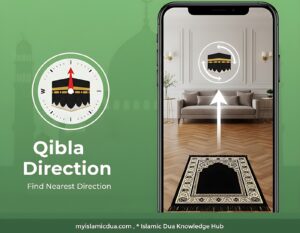
Qibla Direction: Traditional and Modern Methods to Find the Correct Direction for Prayer
Facing the Qibla direction is one of the most essential elements of Islamic worship. No matter where Muslims live whether in vast cities, mountain villages, or distant islands their prayers align toward the Kaaba in Makkah. This sacred orientation unites the global Ummah, connecting hearts toward a single spiritual centre.
Today, many Muslims rely on digital tools to determine the Qibla direction, while others continue to appreciate traditional methods such as observing the sun, stars, and natural signs. This comprehensive guide presents both modern and classical approaches, ensuring you can confidently find the Qibla direction anywhere in the world.
To deepen your understanding of Islamic practices, explore our growing collection of Islamic dua resources at MyIslamicDua.com, which offers spiritually uplifting guidance for your daily worship.
Understanding the Significance of Qibla in Islamic Prayer
Qur’anic Guidance About Qibla
Allah commands believers in the Qur’an:
“So, turn your face toward al-Masjid al-Haram.” (Surah Al-Baqarah 2:144)
This directive establishes facing the Qibla as a mandatory part of valid Salah.
Unity and Spiritual Focus – The Qibla direction symbolizes:
- Global Muslim unity
- Spiritual concentration
- Obedience to Allah
- Connection to the House of Allah
Whether you live in India, Europe, or North America, your prayer direction joins you to millions of believers worldwide.
Why Correct Qibla Direction Matters – Facing the Kaaba enhances:
- Presence of heart
- Respect for worship
- Consistency in prayer practice
Muslims seeking deeper understanding can explore verified Islamic material through Islamic duas at IslamicDuas.com or darood sharif insights at darood-sharif.com.
Traditional Methods for Determining the Qibla Direction
Using the Sun’s Position
For centuries, Muslims used the sun’s movement to identify the Qibla. Twice a year on May 28 and July 16 the sun is directly above the Kaaba at around 12:18 PM Makkah time.
At these moments:
- Any vertical object casts a shadow pointing away from the Qibla.
- Observers worldwide can determine the direction accurately.
Observing Stars and Constellations
Before modern instruments, travellers and scholars used:
- The North Star (Polaris)
- Constellations
- Latitude calculations
This method requires experience and clear night skies, but it remains an authentic traditional practice.
Historical Muslim Navigation
Early Muslim navigators combined:
- Geography
- Astronomy
- Shadow measurement
- Seasonal wind patterns
Their knowledge shaped early mosque architecture across the world.
Modern Technological Solutions for Finding Qibla
The Qibla direction is the sacred orientation Muslims face during Salah, pointing toward the Kaaba in Makkah. This guide explains easy and accurate ways to find the Qibla from traditional methods like observing the sun and stars to modern tools such as smartphone apps, online calculators, and magnetic compasses. Whether traveling, living abroad, or newly embracing Islam, you can confidently determine the Qibla anywhere on Earth. Learn how mosques ensure accuracy, understand common mistakes to avoid, and explore beginner-friendly techniques for quick Qibla identification.
Using Smartphone Apps – Mobile applications use:
- GPS
- Gyroscope sensors
- Digital compass data
Popular apps include:
- Muslim Pro
- Al-Moazin
- Qibla Compass
Apps provide instant accuracy, prayer times, and Islamic calendars. Users seeking Islamic finder tools can also visit IslamicFinder.in for additional guidance.
Online Qibla Calculators – Web-based tools determine Qibla direction by:
- Using your coordinates
- Calculating the angle toward Makkah
- Displaying the bearing visually
These tools are helpful when you cannot install apps.
Digital and Magnetic Compasses
Digital compasses provide:
- Degree measurements
- Real-time orientation
- Magnetic accuracy with declination correction
They are widely used in remote areas, during travel, and in mosques.
Using Physical Compasses for Qibla Determination
Magnetic Compass Method
To use a compass effectively:
- Find the Qibla bearing for your city.
- Adjust for magnetic declination (difference between true north and magnetic north).
- Rotate the compass until the needle aligns properly.
- Face the corrected direction.
Qibla Compasses
These special compasses include:
- City codes
- Pre-calculated Qibla bearings
- Kaaba indicators
They are simple, lightweight, and require no electronics.
Mathematical Calculation of Qibla Direction
Those with technical interest can calculate Qibla using the great-circle formula, which represents the shortest path on a sphere.
Required coordinates:
- Your location (latitude + longitude)
- Kaaba coordinates: 21.4225° N, 39.8262° E
The calculation uses trigonometric equations and reveals the exact initial bearing to face the Qibla.
Qibla Direction in Mosques and Islamic Centres
Mosques worldwide include precise architectural features:
- The mihrab, marking the Qibla wall
- Prayer rows aligned perpendicular to the Qibla
- Surveyed orientation during construction
If uncertain at home, you can rely on the mosque’s direction or seek help from local scholars.
How Beginners and New Muslims Can Find Qibla Easily
- Ask local Islamic centres for help
- Use simple mobile apps
- Observe the prayer direction in mosques
- Look for Qibla signs in hotels, airports, and hospitals
Visit the Islamic guest post community at Mashallah.me or NaazKhan.com for beginner-friendly Islamic resources.
Step-by-Step Guide: How to Find Qibla Direction Easily
- Identify your current location.
- Use a trusted Qibla app with GPS enabled.
- If using a compass, adjust for magnetic declination.
- Compare results using an online Qibla calculator.
- Observe mosque orientation nearby.
- Use sun position if apps fail.
- Look for hotel Qibla signs when traveling.
- Confirm with at least two methods.
- Mark the direction for future prayers.
Comparison Table: Traditional vs Modern Qibla Methods
| Method | Accuracy | Tools Needed | Suitable For |
| Sun alignment | High | Sunlight | Outdoors |
| Stars / Polaris | Medium | Night sky | Rural areas |
| Magnetic compass | High | Compass | Travel |
| Qibla compass | High | Pre-set tool | Home/masjid |
| Smartphone apps | Very high | Phone + internet | Most users |
| Online calculators | High | Browser | Planning spaces |
Common Mistakes to Avoid
- Ignoring magnetic declination
- Using a faulty or uncalibrated compass
- Using a phone in airplane mode
- Misreading maps
- Relying on unreliable apps
Double-checking methods ensures accuracy.
Flexibility in Islamic Jurisprudence
Islamic scholars agree:
- Allah does not burden believers beyond their capacity.
- If exact Qibla cannot be determined, sincere effort is sufficient.
- Prayers remain valid when performed with honest intention.
Islamic Resources to Deepen Your Knowledge
Strengthen your spiritual journey with verified online Islamic sources:
- Explore powerful duas at Islamic dua (MyIslamicDua.com).
- Read authentic dhikr and supplications at Islamic duas (IslamicDuas.com).
- Learn more Islamic knowledge through Islamic finder tools at IslamicFinder.in.
- Discover beneficial writings at Islamic guest post platforms NaazKhan.com and Mashallah.me.
- Read spiritually uplifting darood sharif collections at Darood-Sharif.com.
- Praise Allah with gratitude through alhamdulillah reflections at Alhamdulillah.one.
FAQ
- What is the Qibla direction in Islam?
It is the direction Muslims face during prayer, pointing toward the Kaaba in Makkah.
- Why must Muslims face the Qibla?
It is a Qur’anic command and symbolizes unity among Muslims.
- Can I pray without knowing the Qibla?
Yes, if you make sincere effort and still remain uncertain.
- Do smartphones giveaccurateQibla direction?
Yes – when GPS and compass sensors are calibrated properly.
- Is a slight deviation from Qibla allowed?
Minor deviations do not invalidate Salah according to scholars.
- Can I use the sun to find Qibla?
Yes – especially during the days when the sun aligns above the Kaaba.
- Do mosques always face the perfect Qibla?
Most mosques undergo professional surveying to ensure accuracy.
- Is magnetic declination important?
Yes – it helps correct compass readings.
- How can travellers find Qibla quickly?
Use mobile apps, online tools, or Qibla signs in hotels and airports.
- What if two methods give different directions?
Choose the direction supported by reliable tools and local Islamic authorities.
Conclusion: Finding the Qibla direction is essential for valid prayer and connects Muslims worldwide. This comprehensive guide covers practical methods to locate the Qibla, including sun alignment, star observation, digital compasses, GPS-enabled apps, and online Qibla calculators. It also explains how travellers, new Muslims, and remote communities can determine the correct direction with simple tools. Designed according to authentic Islamic sources, this guide ensures accuracy, ease, and confidence in facing the Kaaba during Salah.